


SKU:
Emotions Level 2 Feelings Cards for Kids
Couldn't load pickup availability
30 Audio-Enabled Emotion Cards with Guided Questions for Understanding Feelings, Perspectives and Why People Feel the Way They Do
As children's emotional understanding develops, they need to move beyond simply naming basic feelings.
They begin to understand that different situations can cause different emotions, that people may feel differently about the same event, and that we can use clues to work out how someone might be feeling.
Emotions Level 2 – How Are They Feeling? builds on early emotion recognition by introducing children to six more advanced emotions across 30 illustrated, audio-enabled cards with guided questions.
Each emotion is explored through four different real-world situations, helping children understand that feelings are connected to what happens around us.
The guided questions encourage children to look for clues, think about what happened, consider another person's perspective and explain why they think someone feels a certain way.
Recommended for children aged 4+, this resource supports emotional vocabulary, perspective-taking, empathy, social awareness, comprehension, expressive language and social communication.
Is your child ready to understand more complex emotions?
This resource can help if your child:
-
Can identify basic emotions but is ready for more advanced feelings
-
Needs support understanding why someone might feel a particular way
-
Finds it difficult to use clues to identify emotions
-
Needs practice thinking about another person's perspective
-
Can name an emotion but struggles to explain why someone feels that way
-
Needs support talking about emotional situations
-
Is developing empathy and social awareness
-
Benefits from visual, audio and guided language support
Why is understanding emotions more than naming them?
Learning:
“Happy.”
is an important first step.
But emotional understanding becomes more sophisticated when children can think about:
“How is she feeling?”
“What happened?”
“What clues tell us that?”
“Why might she feel that way?”
“How would you feel if that happened to you?”
These questions help children move from simply labelling an emotion to understanding the relationship between situations, feelings, thoughts and responses.
From emotion recognition to emotional reasoning
Emotions Level 2 supports an important progression:
Notice the situation → Identify clues → Recognise the emotion → Explain why → Consider another person's perspective → Think about what might happen next
A child may first say:
“She is worried.”
With guided questioning, they can begin to explain:
“She is worried because she doesn't know where her mum is.”
Then think beyond the immediate answer:
“What could help her feel better?”
This moves emotional language towards reasoning, perspective-taking and social problem-solving.
Six advanced emotions in different situations
The deck introduces six advanced emotions, with each emotion presented across four different scenarios.
This repeated exposure is important because children need to understand that an emotion can occur in many different situations.
For example, a person might feel the same emotion because of:
-
Something that happened to them
-
Something that happened to another person
-
Something they expected
-
Something they were worried about
-
A change in their situation
-
A social interaction
Seeing the same emotion in different contexts helps children develop a more flexible and meaningful understanding of feelings.
They learn that emotions are not simply labels attached to particular facial expressions.
Guided questions that support emotional reasoning
A key feature of Level 2 is the use of guided questions.
Instead of simply asking:
“How is she feeling?”
the guided questions help children work through the situation.
For example:
How is she feeling?
If the child is unsure:
What happened?
What do you notice about her face or body?
What might she be thinking?
How would you feel if this happened to you?
Then return to:
How is she feeling?
This gives children a structured way to look for clues, connect the situation with the emotion and explain their thinking.
The questions can be gradually reduced as children become more confident and independent.
Audio-enabled for listening and language modelling
Every card is audio-enabled, providing spoken language support through the Chatter Bugs app.
Children can listen to:
-
The main question
-
The guided questions
-
Emotion vocabulary
-
Language describing the situation
-
Model responses
This gives children opportunities to see, hear, think about and practise emotional language.
The audio support provides an additional language model for children who benefit from repeated spoken input and is particularly useful for children developing English as an additional language.
Through the Chatter Bugs app, audio-enabled resources can also provide multilingual language support.
What skills does Emotions Level 2 support?
Advanced emotional vocabulary
Children expand beyond basic emotion words and develop language for more complex feelings.
Emotion recognition
Children learn to identify emotions from situations, clues and context.
Emotional reasoning
Children practise connecting what happened → how someone feels → why they might feel that way.
Perspective-taking
Children begin to consider what another person might be thinking, feeling or experiencing.
Empathy
Understanding another person's emotional experience provides an important foundation for empathetic responses.
Social awareness
Children learn to notice how situations and interactions can affect people's feelings.
Comprehension
Children practise understanding situations and the relationships between events and emotions.
Expressive language
Children develop language for describing and explaining feelings.
Conversation skills
Children practise answering questions, explaining their thinking and discussing social situations.
Social problem-solving
Thinking about what someone might feel and what could happen next encourages children to consider possible responses and solutions.
From naming a feeling to explaining it
A child may initially answer:
“Worried.”
With guided questions, this can become:
“She is worried.”
Then:
“She is worried because she doesn't know where her mum is.”
And eventually:
“She is worried because she can't find her mum. She might feel better when her mum comes back.”
This progression helps children use emotional vocabulary as part of meaningful reasoning and conversation, rather than simply memorising emotion labels.
How to use the cards
Show your child the illustration and give them time to look carefully at the situation.
Start with:
“How are they feeling?”
If your child answers independently, ask them to explain their thinking.
If they are unsure, use the guided questions to help them identify the clues.
For example:
Adult: “How is the girl feeling?”
If needed:
“What happened?”
“What do you notice?”
“What might she be thinking?”
“How would you feel if that happened to you?”
Then return to:
“So how is she feeling?”
Once the emotion has been identified, extend the conversation:
“Why does she feel that way?”
“What could happen next?”
“What might help her?”
Use the audio to reinforce the questions and provide spoken language models.
From supported reasoning to independent thinking
The guided questions provide a scaffold.
At first, children may need several prompts to identify the relevant clues and explain the emotion.
With repeated practice, they may need fewer prompts.
Eventually, they can begin to independently think:
What happened?
How does the person feel?
What clues tell me that?
Why might they feel that way?
What might happen next?
This supports increasingly independent emotional understanding and social reasoning.
Connecting emotions to your child's own experiences
Once your child has discussed the emotion on the card, connect it to their own life.
Ask:
“Have you ever felt like that?”
“When did you feel that way?”
“What happened?”
“What helped you?”
This gives children opportunities to transfer the emotional vocabulary and reasoning skills from the cards into real-life communication.
Who can use Emotions Level 2?
This resource can be used by:
-
Parents and caregivers
-
Teachers and educators
-
Speech and language professionals
-
Counsellors and child-development professionals
-
Children developing emotional vocabulary
-
Children developing social communication
-
Children developing perspective-taking
-
Children learning English as an additional language
-
Children who benefit from visual, audio and guided language support
The cards can be used during short, focused activities or naturally incorporated into conversations, stories, play and everyday social situations.
Designed for meaningful language development
Brainy Bug Resources creates language-development resources for children, designed by speech therapists and child-development specialists with hands-on clinical and classroom experience.
Our resources are built around developmental progression, with vocabulary selected for its relevance to children's real-world experiences and sequenced to support growing communication.
The Brainy Bug range supports children from first words and early vocabulary through word combinations, sentences, descriptive language, question forms, verbal reasoning, narrative and conversational skills.
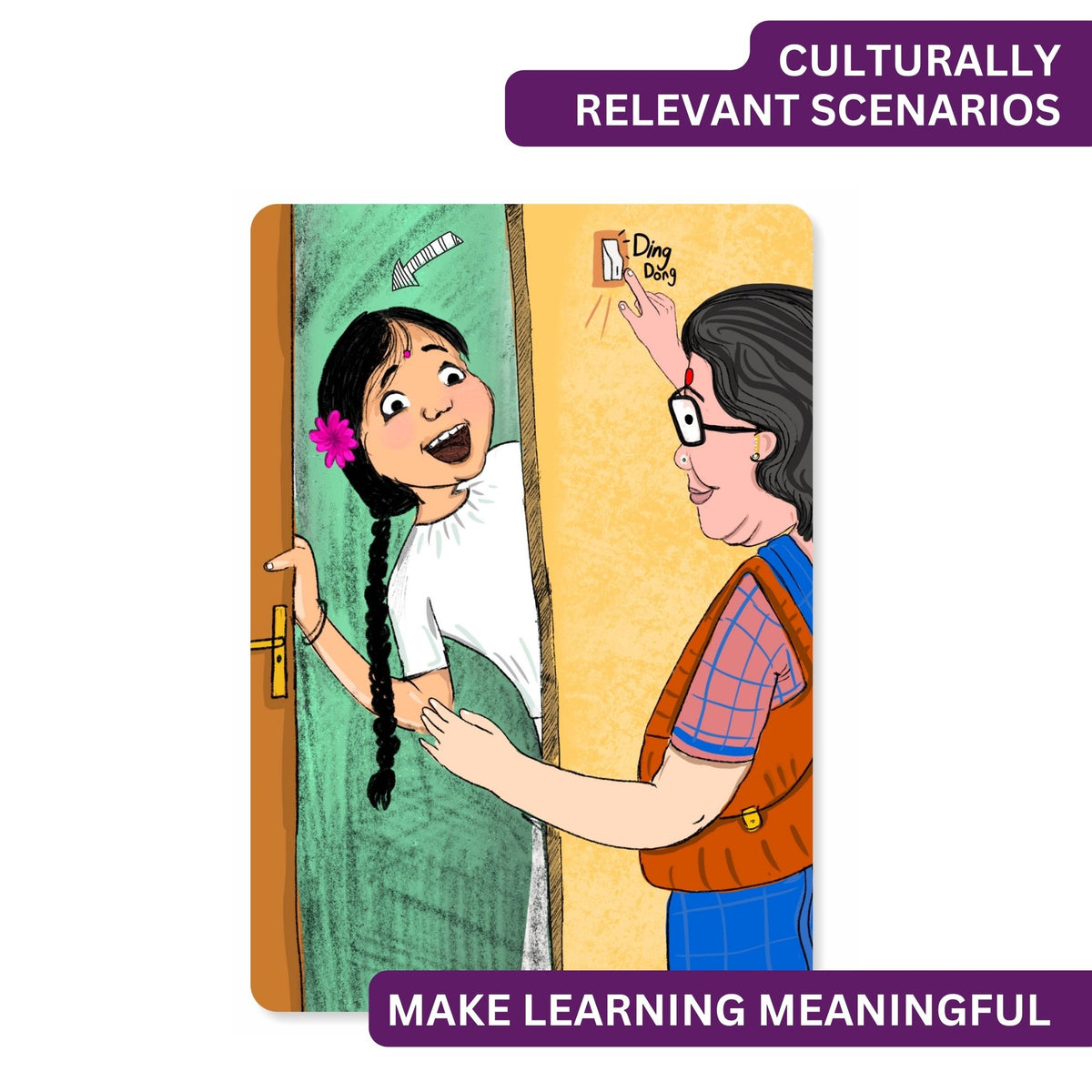
The illustrations reflect familiar Indian contexts, helping children connect new language with the world around them.
Audio-enabled resources provide an additional layer of support, allowing children to hear and practise target language through the Chatter Bugs app.
Level 1 to Level 2: growing emotional understanding
Emotions Level 1 helps children build a foundation for recognising and naming basic emotions in familiar situations.
Emotions Level 2 takes the next step.
Children begin to explore more advanced emotions, different emotional situations, reasons for feelings, perspectives and possible responses.
The progression is:
Recognise → Name → Notice clues → Explain why → Take another person's perspective → Think about what might help
This makes Level 2 a natural next step for children who already have a foundation in basic emotion vocabulary.
Helping children understand feelings in context
Knowing the word for an emotion is only the beginning.
Children also need to understand:
What happened?
How does that make someone feel?
Why might they feel that way?
What might they do next?
How might someone else feel in the same situation?
Emotions Level 2 gives children repeated opportunities to explore these connections through visual situations, audio support and guided questions.
Product Details
-
30 audio-enabled emotion cards
-
Six advanced emotions
-
Four different scenarios for each emotion
-
Guided questions to scaffold emotional reasoning
-
Clear, child-friendly illustrations
-
Audio support through the Chatter Bugs app
-
Multilingual audio support
-
Recommended for children aged 4+
-
Builds advanced emotional vocabulary
-
Supports emotion recognition and understanding
-
Develops perspective-taking and empathy
-
Supports social awareness
-
Develops comprehension and expressive language
-
Encourages emotional reasoning
-
Supports conversation and social communication
-
Suitable for home, classroom and speech and language activities
See the situation. Notice the clues. Understand the feeling. Think about why.
Spread Joy with Our Special Offers
Brainy Bug Resources make perfect gifts
Resources for All Ages and All Abilities
Fuel Language with Discounts on Brainy Bug Resources
-
Vendor:
My Store
- Tags: Ages 4 plus, Educational toys, Emotional literacy, Emotions, Empathy, Feelings, Flashcards, Kids, Learning cards, Social skills


- Who We Are
- What Makes Us Unique
Brainy Bug Resources creates language development resources for children, designed by speech therapists and child development specialists with hands-on clinical and classroom experience. Every product is built around developmental norms — vocabulary is chosen for its relevance to a child's real world, sequenced in the order children naturally acquire language, and illustrated with culturally familiar Indian imagery. Our resources take children from single words all the way through to sentences, verbal reasoning, and conversational skills. Used by parents, teachers, and speech therapists wherever children are learning to communicate.
Every word in every deck is chosen deliberately — not for novelty, but because it matters to a child's life and language growth. Our resources follow the developmental sequence children naturally use to acquire language, which means learning builds correctly from the start. Illustrations reflect the Indian context children actually live in, making concepts easier to grasp and retain. Select decks are audio-enabled via the Chatter Bugs app, giving children access to pronunciation support and content in up to 9 languages including Hindi, Tamil, Kannada, Telugu, and Punjabi. Our range spans the full learning journey — from a child's first words to advanced skills like narrative, reasoning, and question forms — so parents and professionals can find the right resource at every stage.

Lightning Deal Ends In ...
Help your child take their first steps towards independent reading with this essential phonics resource. Word Families Level 1 introduces 34 of the most important sound patterns in English, giving children the tools to recognise spelling patterns, decode new words, and build reading confidence from the ground up.
💫 More Value. More Savings.
💫 More Value. More Savings.
💫 More Value. More Savings.
💫 More Value. More Savings.
💫 More Value. More Savings.
💫 More Value. More Savings.
💫 More Value. More Savings.
💫 More Value. More Savings.
💫 More Value. More Savings.
💫 More Value. More Savings.
Learning Sets to Teach Key Language Skills
Helping children understand, express, and connect
🧸 Early Learners Smart Bundle
Designed for children just beginning their language journey, this bundle supports early development—where children learn to understand words, name what they see, and make sense of their world. At this stage, learning needs to be simple and visual.
These tools help build a strong foundation, supporting children as they move from understanding words to starting to express themselves.
🚀 Sentence Learners Smart Bundle
Designed for children ready to move beyond single words, this bundle supports the stage where children begin forming sentences and expressing ideas more clearly.
These tools guide that transition, helping children organise their thoughts and move from simple phrases to meaningful sentences. Different decks teach a different set of essential skills; each designed to expand sentence combinations.
🌟 Advanced Learners Smart Bundle
Designed for children ready to move beyond single words, this bundle supports the stage where children begin forming sentences and expressing more complex ideas. At this stage, language and academic learning are closely linked, to learn, understand, and participate.
These tools guide that transition, helping children organise their thoughts and move from simple phrases to meaningful sentences.
🎯 Full Range of Products
Designed for children across different stages of language development, this collection is ideal for professionals working with a wide range of learners and needs.
It offers flexibility and strong value for money, providing a comprehensive set of tools that can be used across levels, goals, and settings without the need for multiple separate resources. One complete set to support every stage of language development.